
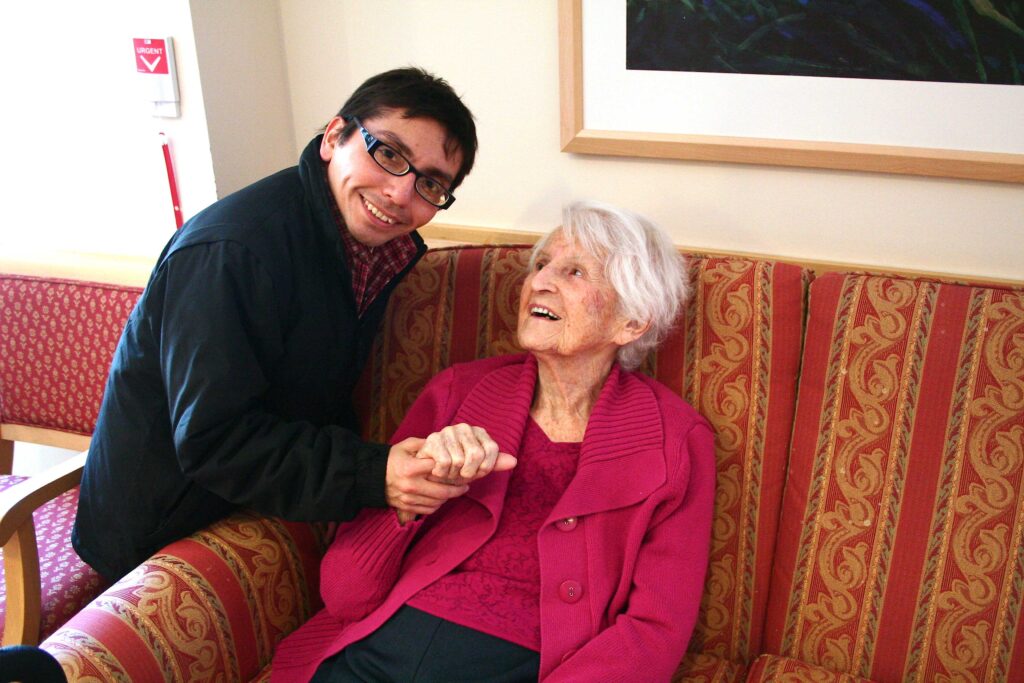
For many years I have been trying to comprehend how a person with dementia relates to a world which shrinks at an untouchable pace. As a palliative care chaplain for almost two decades now, I have been interacting with and counselling many who suffer from this illness, as well as walking alongside their children, grandchildren, family in general, friends, and even the nurses and PSWs who attend to them. It is a long walk that must be walked with patience and dignity.
More than once, I have asked myself: how does a person with dementia really see me, or how effective are my words of encouragement to them, or if I am making any difference in their lives. I know I am not the only one thinking this way; many times I have had conversations with the family and friends of those with dementia where these issues arise.
In my experience, I have found something to be true: even though memories get erased, and faces are no longer familiar, and words lose their meaning, the intrinsic humanity within a person does not get affected. Even though the body seems not to respond, the very essence of a person’s soul does not change.
Let me explain it this way: when we come into the world, we have no memories, no speech, no language and no mobility; we do not know faces, and we don’t know the function of any of our senses. We are totally blank, yet we can perceive the touch of a caring parent. As babies, we can sense tension and strife, fear and neglect, and definitely we can perceive love and care. Even before we can respond with emotions, we can absorb emotions, and before we know the meaning of words, we are able to feel and grasp the intention of the words spoken to us. This is our inherited raw humanity that transcends words in any language to the universality of our human soul. This is what I am calling the very essence of a person’s soul. It has been there from the moment God created us at our conception, and will be there beyond the moment we become free from our mortal body. It has eternity within, and though fallen in nature, it bears the image of God (Gen 5:1).
As a person unwillingly and unaware discontinues the regular synapses, memories and logic begin to vanish, familiar faces and words become strange, and the body forgets how to express itself; yet, the ability to perceive the world as babies does not change. The soul inside is intact and able to discern care, love and the intention of a friendly voice.
A few people that I visit cannot recognize me anymore, but I still feel very welcomed when I approach them, because I know they take me as a friendly person even though I am, every time, a total stranger to them. When I hold the hand of a resident, when I sing them a song, or speak or pray with them, even if I don’t receive an answer, I know they are perceiving and absorbing the heart behind my words. They are listening.
When we talk to them, when we tell them about the things we are doing for them, when we converse with them or sing to them our favourite tune as we help them, when we tell them a funny anecdote from our day, or a memory dear to us, or how our children are doing. We are honouring them. We are expressing to them that they are important and that we value them. They are always listening. Every communication counts.
Knowing this encourages me and gives me patience. I count them all as our parents, and one day, with or without dementia, we will age, and we will need help, and our children will pick up the duty of caring for us, as we now have the duty to care for our parents. Let’s show our children how it is done. Paul encourages us to honour our parents in Ephesians 6:2. So, even though it can be very frustrating, let us be patient when we have to repeat ourselves, when we have to remind them to take their medication, or when we are helping to clean them. In reality, not too long ago they did the same for us. May God give us strength and patience as we serve our mom, or our dad, or our spouse, or a resident if you are a PSW or a nurse. May God give us strength, wisdom and words of encouragement.
Photo: With Granny in 2011. “Love many, trust few, always paddle your own canoe”